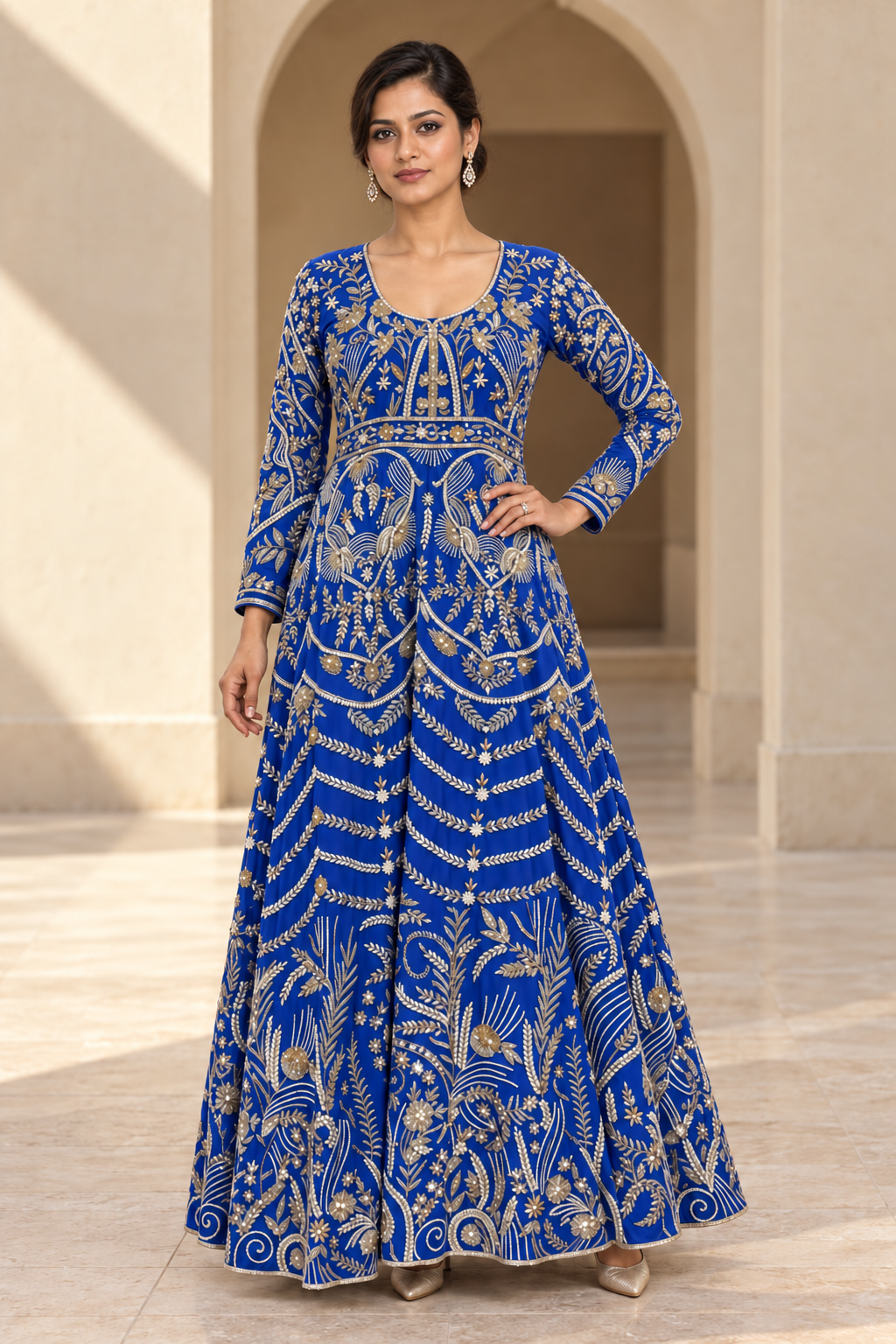
How do you recognise the silhouette?
Look at the outline before the decoration. An Anarkali is usually closer to the body through the bodice and opens into a skirt that widens as it falls, often reaching mid-calf, ankle or floor. Where the flare begins varies: some start just under the bust, others nearer the natural waist.
How the fullness is created varies too. Some makers cut many flared panels, some gather fabric into the waistline, and some combine both. Names shift between regions and sellers, so the shape is a more reliable guide than the label. When you look at a photograph, check for:
- A closer-fitting upper body
- A clear point where the skirt begins to widen
- A length well below the knee
- A hem that swings outward when the wearer turns
Does an Anarkali always come as a set?
No. Many are sold as a suit or set, typically pairing the dress with fitted trousers and a dupatta, but what a listing includes is the seller's choice. A photograph showing a dupatta over the shoulder does not confirm that one is part of the purchase.
| Piece | What to confirm | Why it matters |
|---|---|---|
| The Anarkali itself | Length, sleeve length and how it fastens | Decides how the outfit moves and how you dress |
| Trousers or leggings | Whether they are included, and their style | They show at the hem and when you sit or dance |
| Dupatta | Whether it is included, its length and edging | Changes how the outfit reads and what you carry |
| Lining or slip | Whether it is built in or worn separately | Affects opacity and how the skirt falls |
If a piece is not confirmed in writing, plan as though you will need to source it yourself.
Which details change the feel?
Two Anarkalis with the same outline can feel quite different. These are the details that most change the effect. Treat them as style observations, not rules about who should wear what.
- Fullness of the skirt: a modest flare reads quieter; a very full one moves dramatically and takes up more room when you sit.
- Length: floor length feels formal and needs attention on stairs; shorter lengths show more of the trousers and shoes.
- Sleeves: long sleeves give a finished, covered line and matter when you plan outer layers or bangles.
- Neckline: a rounded neck leaves space for a necklace; a higher or more decorated neck may need little jewellery.
- Decoration placement: motifs scattered over the skirt carry the eye downward; a decorated border draws attention to the hem.
- Drape: a soft fabric falls close and fluid, while a crisper one holds the flare outward. Ask what the fabric is rather than judging from a photograph.
What can you see in the KAVEYRA piece?
KAVEYRA currently lists one piece, the Royal Blue Anarkali, at USD 2,800. Its photographs show a long flared silhouette, long sleeves, a rounded neckline and pale-gold floral and bird motifs. Fibre, decoration technique, sizing and included pieces are not yet confirmed, and some images are digitally styled or cropped close views. Orders are not yet open.
Read the photographs as a guide to shape and colour rather than construction. The table above doubles as a list of questions to bring once fuller details are published.
Reference: KAVEYRA: Royal Blue Anarkali
YOUR NEXT STEP
Before comparing any Anarkali, write down every piece you need for the occasion, then confirm each one against the listing rather than assuming the word “set” covers it.