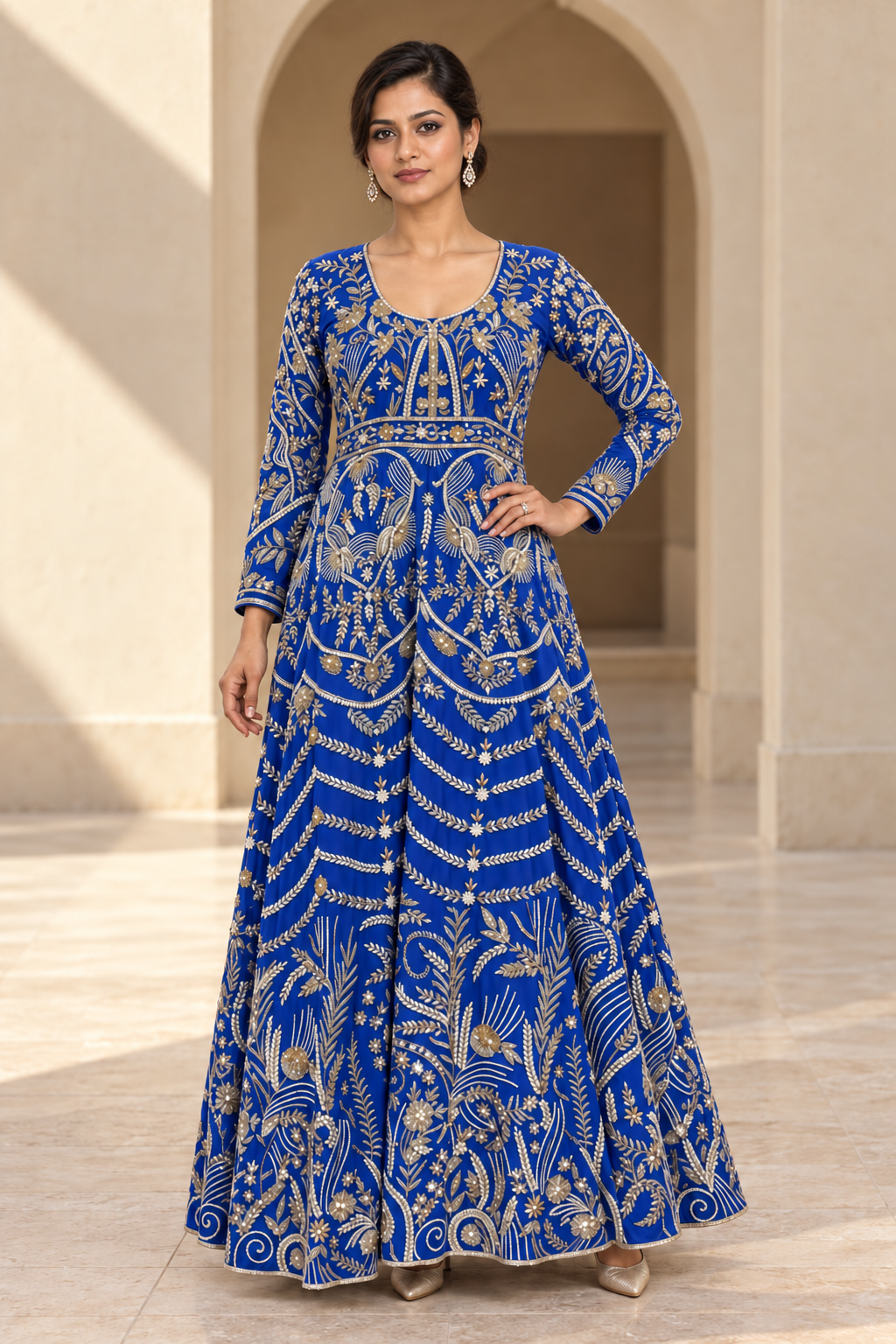
What is the main difference?
Each silhouette places its volume somewhere different. Use this as a broad guide: makers combine and rename these shapes freely, and hybrids are common.
| Silhouette | Usual main pieces | Where the volume sits | How it moves |
|---|---|---|---|
| Anarkali | Long flared dress, trousers, often a dupatta | In the skirt of the dress, from the bodice down | Swings as one piece when you turn |
| Lehenga | Blouse, separate full skirt, usually a dupatta | In the skirt, from the waistband down | Skirt moves independently of the top |
| Sharara | Tunic, wide trousers, often a dupatta | In the trouser legs, widening from the waist | Each leg flares as you walk |
How do the pieces work together?
An Anarkali is the most self-contained: one main garment over fitted bottoms. Because the dress carries the whole look, the trousers mostly show at the hem and when you sit.
A lehenga and a sharara are built from separates. That can make top and bottom more independent, and opens the possibility of wearing pieces with other things later. It also means more waistbands, closures and seams to check, and two pieces that must sit correctly together all evening.
The dupatta is the shared variable. With an Anarkali it often falls over one or both shoulders; with a lehenga it may be draped or pinned across the body; with a sharara it can balance the width below. How you wear it affects your bag, your jewellery and how free your hands are.
Which questions help you choose?
- Will you sit on the floor, on low seating or on chairs, and for how long?
- Will you dance, and do you want the movement to come from a skirt or from trousers?
- Are there stairs, a stage or uneven ground between you and your seat?
- Do you need to dress without help?
- Would you like to rewear parts of the outfit separately?
- How easily can you manage the outfit in a small restroom?
- What will the weather and the venue temperature ask of you?
Answer these honestly before looking at colour or decoration. They narrow the choice faster than any image.
A comparison for your next occasion
Match your answers against the considerations below. They are practical observations, not rules, and individual garments vary.
| If your occasion involves… | Anarkali | Lehenga | Sharara |
|---|---|---|---|
| Lots of dancing | Full skirt swings; check length with your shoes | Skirt moves freely; check the waistband stays put | Trouser flare moves; check hems near your feet |
| Floor seating | Skirt pools around you; practise sitting and rising | Skirt spreads easily; blouse length matters | Wide legs fold around you; tunic length matters |
| Stairs or a stage | Lift the front of one long skirt | Lift the front of the skirt | Check both wide trouser hems before climbing |
| Dressing quickly | Fewer pieces to fasten | More pieces to coordinate | More pieces to coordinate |
| Cold weather | One long layer sits under a coat | Check whether the blouse leaves skin exposed | Tunic and trousers layer readily |
KAVEYRA currently lists a single Anarkali, so this comparison is meant to help you decide whether that silhouette suits your plans before you consider any one piece.
Reference: KAVEYRA: Royal Blue Anarkali
YOUR NEXT STEP
List the three moments of your occasion that demand the most movement, then check each against the comparison table before you shortlist a silhouette.