What needs warmth and when?
If your winter occasion is mainly indoors, an outer layer may be needed only for parts of the journey. If any event is outdoors, plan warmth for its full duration. Start by mapping each stage.
| Stage | Where you are | What feels the cold | A layering idea |
|---|---|---|---|
| Leaving home | Doorstep to car or transit | Arms, neck, hands | Full outer layer and gloves |
| Travelling | Car, train or rideshare | Feet and legs while seated | Warm boots to change out of later |
| Walk to the entrance | Parking area or street | Everything, plus a hem near wet or salted ground | Coat closed, skirt lifted |
| Entrance or coat check | Doorway | Very little once inside | A layer that is easy to remove in a crowd |
| Outdoor photographs | Steps or garden | Arms and shoulders | A wrap you can drop for a few frames |
| Departure | Late night, colder | Everything | The arrival layer, ready to hand |
Which layer fits over decorated sleeves?
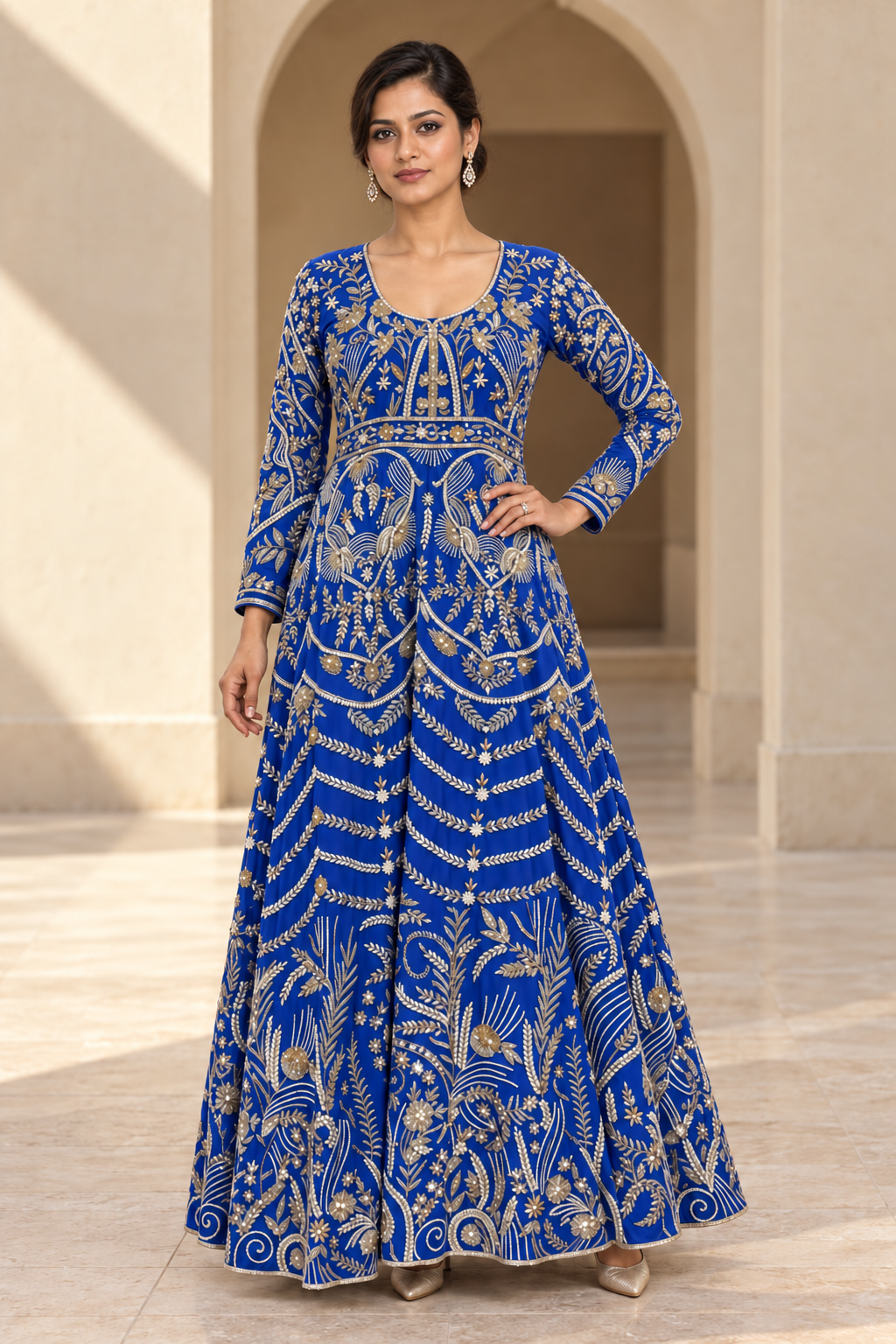
Long sleeves with surface decoration are the main constraint. A coat with narrow sleeves can drag across motifs each time it goes on, and rough linings, zips, hook-and-loop tabs or beaded cuffs can catch. KAVEYRA's photographs, for instance, show long sleeves with pale-gold motifs whose technique is not yet confirmed; with any decorated sleeve, assume it could snag until you know otherwise.
Options worth trying, as style suggestions rather than rules:
- An open-front shawl or wrap, which avoids sleeves altogether.
- A cape or poncho-style coat that drops over the shoulders.
- A coat with roomy sleeves and a smooth lining; test it rather than judging by eye.
- A long coat if you want the skirt covered, though a full flare may crush beneath it; a shorter coat leaves the skirt free.
Reference: KAVEYRA: Royal Blue Anarkali
What happens to the dupatta and bag?
Decide where the dupatta travels before you leave. Worn under a coat, it can crease or bunch; folded loosely into a tote, it may arrive neater but needs arranging at the venue. Either works if you have practised it.
A shoulder strap presses on the shoulder and upper sleeve all evening. A clutch or wrist-held bag keeps pressure off any decoration. If you are changing from boots into event shoes, plan a second bag for the boots and decide where it goes: coat check or the car.
Try the full arrival-to-seat sequence
One rehearsal at home, in everything you will wear and carry, shows what the evening will ask of you.
- Dress completely, including jewellery and the dupatta.
- Put on the outer layer and gloves, then pick up every bag.
- Walk through your home as if leaving, then sit for a few minutes as you would in the car.
- Stand, and practise lifting the skirt as you would on the walk to the entrance.
- Remove the outer layer while holding your bag, as you would at a busy coat check.
- Change shoes, if planned, and stow the boots.
- Arrange the dupatta, check your sleeves for snags or pulled threads, and sit down.
Time the whole sequence. If removing the coat needed help or a free surface, choose a different layer now rather than on the night.
YOUR NEXT STEP
This week, try your intended coat over a long-sleeved, textured top and check for catching, then run the full arrival-to-seat sequence once in the complete outfit.