What does each photograph need to show?
Every image on a product page is doing one of two jobs. Some set a mood: a styled scene, a pose, a background chosen to suggest an occasion. Others document the garment itself. Both are legitimate, but neither should be mistaken for a guarantee of what would arrive. Identified photographs of the actual sample provide more useful evidence than styling concepts.
Before studying details, sort the images. Ask of each one: is this the garment as made, or the garment presented? A useful documentary photograph shows the piece in even light, without heavy shadow or colour grading, at a distance that lets you see where seams, hems and decoration begin and end.
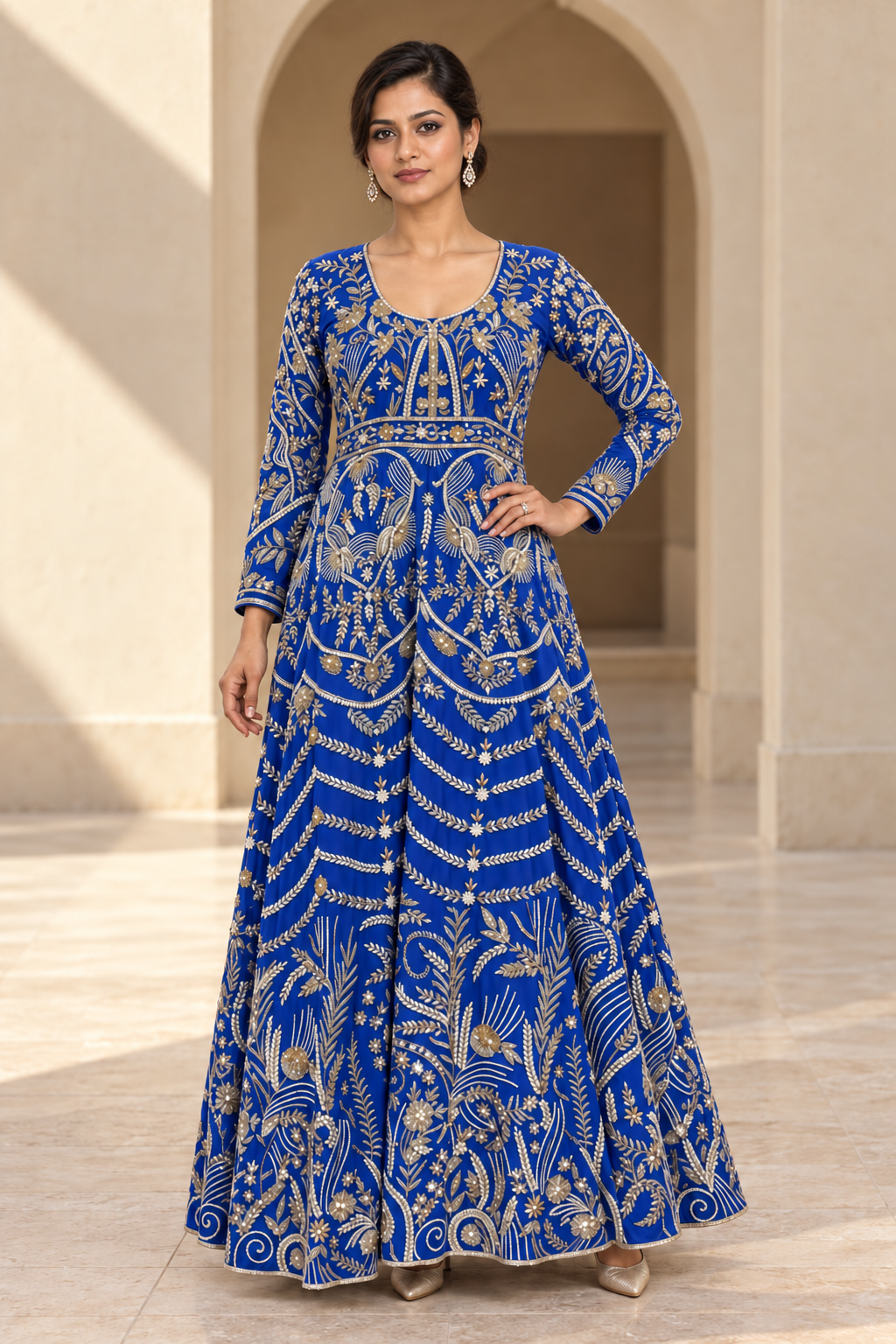
On the KAVEYRA product page, some imagery is disclosed as digitally styled and some close views are cropped. A crop changes framing; it does not create an independent detail photograph. Ask which images document the actual sample and which are styling presentations.
Reference: KAVEYRA: Royal Blue Anarkali
Which views help you assess the garment?
For a long, flared Anarkali, the most informative views tend to be the ones a styled shoot leaves out. Use this table to decide what to request and why.
| View | What it can help you judge | Why it matters for an occasion purchase |
|---|---|---|
| Full front, unstyled | Overall length, flare, sleeve length, neckline shape | Confirms the silhouette you are planning around |
| Full back | Closure position, back neckline, decoration placement | Back views are seen at ceremonies and in photographs |
| Side view | How the flare falls and where volume begins | Helps you picture movement and seating |
| Close view at actual scale | Motif density and spacing, with a reference object if possible | Cropped close-ups can make small motifs read as large |
| Inside view | Whether there is a lining, seam finishing, reverse of decoration | Hints at comfort and construction, though it confirms neither |
| Hem and cuff | Edge finishing and decoration at stress points | These edges deserve a close look before wear |
| Same garment in daylight | Colour without studio adjustment | Royal blue can shift noticeably between lights |
What cannot a photograph prove?
Photographs show appearance, not composition. A pale-gold motif can be visible and still tell you nothing certain about thread, technique or whether metal is involved. A fabric that looks fluid may be one of several structures, and a fabric name alone does not establish fibre content.
Questions only the seller can answer in writing include:
- Fibre composition of the outer fabric and any lining
- How the decoration was made, and whether that was by hand or machine
- Approximate garment weight
- Which pieces are included, such as a dupatta or trousers
- Sizing information and what measurements it relies on
- Care instructions as they will appear on the label
For the KAVEYRA Royal Blue Anarkali, the photographs show a long flared silhouette, long sleeves, a rounded neckline and pale-gold floral and bird motifs. Fibre, technique, sizing and contents are not yet confirmed, so those remain questions rather than conclusions.
Reference: KAVEYRA: Royal Blue Anarkali
A photo request checklist
When enquiries are open, a short, specific request is easier to answer than a general one. Adapt this message:
Hello, I am considering the [garment name] for an event on [date]. Could you share: an unstyled full front and back view; a side view showing the flare; a close view of the motifs with a ruler or coin for scale; an inside view of the bodice and hem; and one photograph in daylight. I would also appreciate written confirmation of fibre, decoration method, included pieces and care label wording. Thank you.
- Note which existing images are styled and which are documentary
- List every view still missing
- Record answers with the date received
- Mark anything still unconfirmed before deciding
YOUR NEXT STEP
Sort the current photographs into styled and documentary, list the missing views from the table, and save the request message to send once enquiries open.